

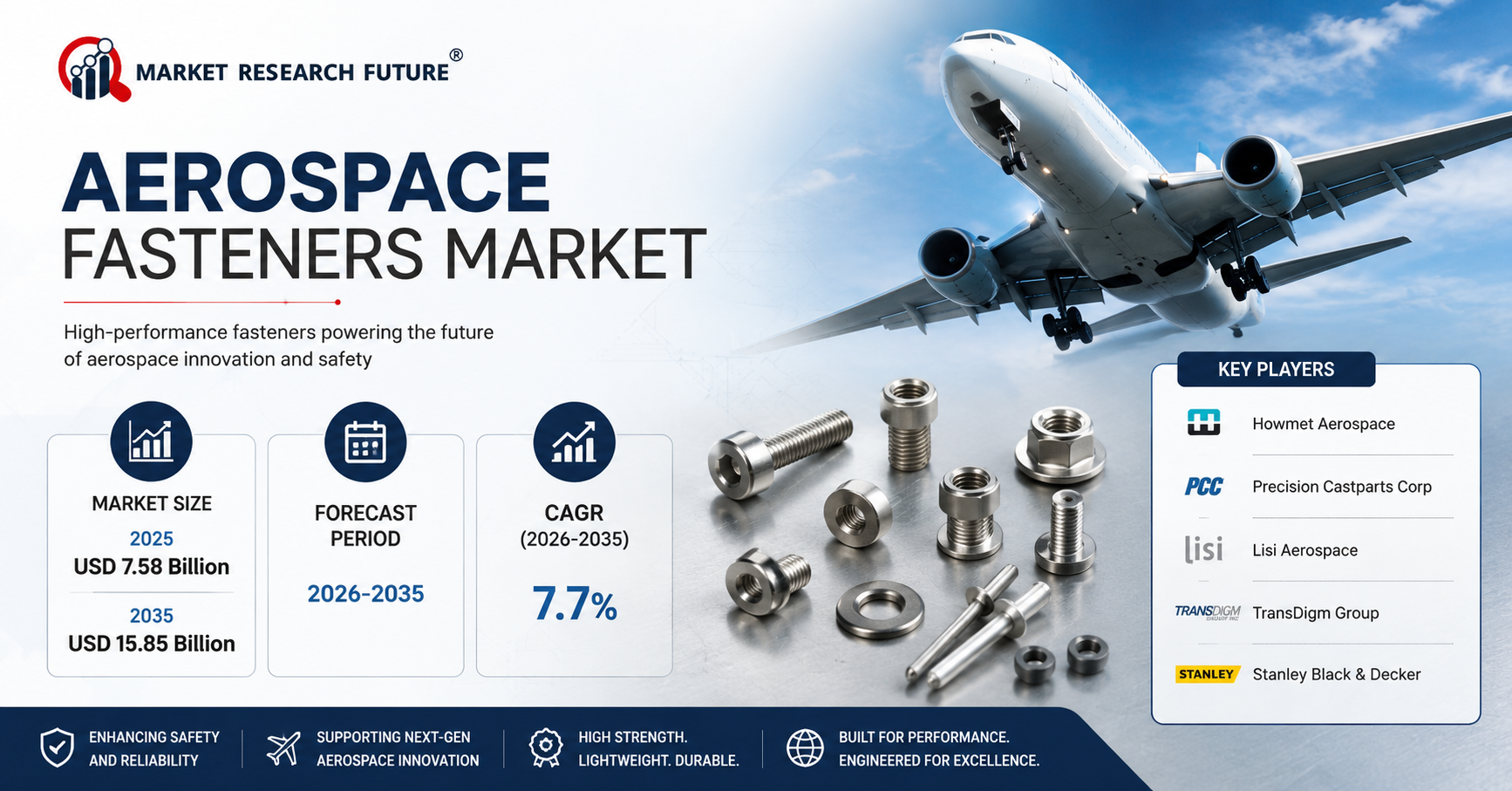
Aerospace Fasteners Market to Double from USD 7.58 Billion in 2025 to USD 15.85 Billion by 2035 at 7.7% CAGR
Aerospace Fasteners Market
Record Aircraft Backlogs, Defense Modernization Drives, and eVTOL Emergence Reshape the Global Aerospace Fastening Landscape
NEW YORK, NY, UNITED STATES, June 24, 2026 /EINPresswire.com/ --Market Overview:
The global Aerospace Fasteners Market was valued at USD 7.58 Billion in 2025 and is forecast to expand from USD 8.13 Billion in 2026 to USD 15.85 Billion by 2035, advancing at a compound annual growth rate (CAGR) of 7.7% across the forecast horizon. This robust expansion is underpinned by record commercial aircraft backlogs—exceeding 14,000 single-aisle jets at Boeing and Airbus combined—which are compelling original equipment manufacturers (OEMs) to accelerate production throughput and, by extension, generate unprecedented demand for high-precision fastening hardware.
Latest Market Trends:
1. Automation and Robotic Fastening at Scale
The proportion of automated fastening operations in narrow-body fuselage join processes is projected to exceed 50% by 2030, up from an estimated 25% in 2024. This shift is fundamentally altering fastener specifications, placing a premium on parts with ultra-tight dimensional tolerances compatible with robotic end-effectors. Suppliers who invest in statistical process control infrastructure and machine-readable inspection documentation are positioned to capture preferred-tier positions with major airframers, as digital traceability is emerging as a competitive differentiator alongside metallurgical quality.
2. Accelerating Adoption of Titanium and Composite-Compatible Fasteners
With carbon fiber-reinforced polymer (CFRP) content exceeding 50% on platforms such as the Boeing 787 and Airbus A350, galvanic corrosion mitigation has become a paramount design concern. Titanium-alloy fasteners—which eliminate the corrosion risk inherent in aluminum-CFRP interfaces—have captured approximately 35.0% of total market share by value as of 2025. Simultaneously, composite-compatible polymer fasteners are advancing at a 9.6% CAGR in secondary-structure applications where electrical isolation and weight minimization outweigh primary load-bearing requirements. OEM qualification programs across Europe and North America are actively validating these materials for broader airframe applications.
3. Smart Fasteners and Embedded Structural Health Monitoring
A transformative trend gaining significant traction is the development and deployment of strain-sensing fasteners incorporating piezoelectric elements. These intelligent fastening systems enable continuous, real-time structural health monitoring (SHM), potentially reducing unscheduled inspection downtime by as much as 30%. The architecture creates a new recurring service-and-analytics revenue stream beyond the hardware sale itself, fundamentally altering the business model for forward-thinking fastener manufacturers. Both Boeing and Airbus have embedded electronic traceability mandates for safety-critical fasteners in their digital-thread initiatives, and this requirement is expected to extend to all structural categories by 2035.
4. Cadmium-Free Coating Transition Under Regulatory Pressure
EU REACH regulations and forthcoming U.S. EPA restrictions are mandating the phased elimination of cadmium plating from new-production aircraft applications by 2027–2029. Suppliers who have successfully qualified zinc-nickel and aluminum-ceramic alternatives—which deliver equivalent corrosion protection without environmental toxicity—are securing preferred-supplier designations in major European OEM programs. This regulatory-driven transition is creating a high-margin product refresh cycle across the industry.
5. eVTOL and Urban Air Mobility Platform Emergence
The FAA's Part 135 and proposed Part 136 certification pathways are crystallizing a commercial regulatory framework for electric vertical take-off and landing (eVTOL) operations anticipated to launch between 2026 and 2028. Leading eVTOL developers, including Joby Aviation, Archer, and Lilium collectively held order books exceeding 18 million euros in late 2025. Critically, eVTOL airframes—though smaller in absolute size—require specialty fasteners at a higher density per kilogram of airframe weight than conventional aircraft, and demand specifically designed quick-release fasteners to enable the rapid battery-swap maintenance cycles central to commercial viability. This represents an entirely new high-margin product category for the aerospace fasteners industry.
Key Growth Drivers:
Single-Aisle Production Ramp-Up
The single most powerful near-term catalyst for the Aerospace Fasteners Market is the simultaneous production rate increase at both major Western airframe OEMs. Airbus has publicly committed to achieving monthly A320neo family output of 75 aircraft by mid-2027, while Boeing is targeting stabilization of 737 MAX production at 56 units per month following completion of regulatory clearance processes. Given that each narrow-body commercial aircraft incorporates between 2.4 million and 3.0 million individual fasteners, every incremental airframe per month generates millions of additional fastener units.
Strategic Opportunities
Several high-value opportunity pockets are emerging within the broader market expansion. Additive manufacturing of complex fastener geometries represents a compelling near-term opportunity: topology-optimized locking fasteners produced via metal AM processes are now achieving densities exceeding 99.5% in titanium alloys, delivering weight savings of 15–20% compared to conventionally machined equivalents.
Recent Developments:
February 2024 — TransDigm Group: Major Portfolio Acquisition:
TransDigm Group officially completed the acquisition of the Electron Device Business from Communications & Power Industries for approximately USD 1.385 billion in cash. The strategic transaction substantially expanded TransDigm's proprietary aerospace aftermarket portfolio across commercial and defense electronics components, reinforcing its high-margin, aftermarket-centric business positioning.
December 2024 — Howmet Aerospace: Major Manufacturing Expansion:
Howmet Aerospace formally secured a state business development grant to underpin a substantial USD 107.5 Million expansion of its Whitehall, Michigan, manufacturing operations. The investment is specifically directed at constructing specialized production infrastructure for advanced ceramic cores used in next-generation commercial and defense jet engine airfoils. The expansion reinforces Howmet's vertically integrated positioning—from raw alloy production through to finished precision fastener systems—and signals the company's confidence in sustained demand growth across both commercial aviation recovery and defense program ramp-up trajectories.
February 2025 — Precision Castparts Corp: Supply Chain Disruption:
A significant fire at Precision Castparts Corp's specialty-metals manufacturing facility in Jenkintown, Pennsylvania, caused a temporary disruption of an estimated 8–12% of North American aerospace-grade titanium fastener capacity. The incident triggered immediate industry-wide inventory reviews and caused aerospace-grade titanium sponge prices to spike approximately 22% in the subsequent quarter, squeezing margins for Tier 2 fastener suppliers operating under fixed-price long-term OEM agreements.
Top Company Profiles:
Howmet Aerospace:
Howmet Aerospace stands as the market's foremost player by revenue share, commanding an estimated 9–12% of global aerospace fastener revenue. The company's competitive strength stems from its end-to-end vertical integration, spanning raw alloy production through to finished precision fasteners marketed under the industry-recognized Hi-Lok and Hi-Lite product families. Howmet's titanium bolt portfolio serves critical structural joints across all major commercial and military platforms.
Precision Castparts Corp (PCC):
A wholly-owned subsidiary of Berkshire Hathaway, Precision Castparts Corp (PCC) commands an estimated 8–11% of the global market through its SPS Technologies brand—one of the most comprehensive aerospace fastener product lines available. PCC's deep capability in superalloy fastening solutions positions it as the preferred supplier for high-temperature engine and exhaust applications. Despite the operational disruption caused by the February 2025 Jenkintown facility fire, PCC's financial resilience and supply chain depth have enabled recovery and reinforce its structural importance to the North American aerospace supply chain.
Lisi Aerospace:
France-based Lisi Aerospace holds the leading position within the European aerospace fastener sector, capturing approximately 7–10% of global market share. The company's Tier 1 supplier relationship with Airbus is its defining strategic asset, providing preferred access to Airbus's high-volume production programs across Toulouse, Hamburg, and Broughton. Lisi's Hi-Lite pins, blind bolts, and temporary fastener product lines are integral to current Airbus assembly processes, while its OPTIBLIND system—due for A350 deployment by 2027—positions the company at the frontier of automated fastening technology adoption.
TransDigm Group:
TransDigm Group's aerospace fastener portfolio—encompassing specialty fasteners and quick-release pins—is deliberately positioned toward the aftermarket channel, enabling the group to sustain high-margin returns independent of OEM production cycle fluctuations. TransDigm's acquisition strategy, most recently exemplified by the USD 1.385 billion Electron Device Business purchase completed in February 2024, consistently expands its proprietary aftermarket revenue base.
Stanley Black & Decker — Aerospace Division:
Stanley Black & Decker contributes to the Aerospace Fasteners Market through its Avdel blind rivet systems and Tucker fastening technologies, capturing an estimated 4–6% of global revenue. The division leverages the group's broad industrial manufacturing infrastructure to deliver cost-competitive aerospace-grade riveting solutions at scale. Avdel's systems are particularly prominent in fuselage skin-panel attachment applications where automated riveting processes are being increasingly adopted by major airframers.
Triumph Group:
Triumph Group differentiates itself through an integrated aerostructures and fastener assembly model, offering bundled kitting services alongside structural fastener assemblies. This approach—capturing an estimated 3–5% of global market revenue—provides OEM customers with supply chain simplification benefits, reducing supplier management complexity.
National Aerospace Fasteners Corp (NAFC):
NAFC serves as a cost-competitive supplier of standard AN/MS specification bolts and specialty pins, maintaining a position on the U.S. DoD Qualified Products List—a critical prerequisite for government program work. The company captures an estimated 2–4% of global market revenue and is well-positioned to benefit from the substantial defense procurement cycles associated with next-generation fighter programs and fleet recapitalization initiatives.
Böllhoff Group:
Germany-based Böllhoff Group brings specialized expertise in thread-insert technology—particularly Helicoil wire thread inserts—and riveted connection systems to the aerospace market. The group captures approximately 2–3% of global market revenue and maintains a strong presence in European OEM supplier bases, leveraging its deep engineering heritage and proximity to Airbus's continental supply chain.
Regional Analysis:
North America — Dominant Market Leader at 33.1% Share:
North America commands the largest share of the global Aerospace Fasteners Market at 33.1% as of 2025, anchored by the unparalleled concentration of commercial OEM throughput and military-industrial capacity within the United States. The U.S. accounts for 78.2% of North American regional revenue, driven by Boeing's South Carolina and Renton production facilities, Lockheed Martin's F-35 program, and Northrop Grumman's B-21 Raider production at Palmdale, California. Mexico's Querétaro aerospace cluster—having attracted over USD 4 billion in cumulative foreign direct investment since 2015.
Europe — Established Ecosystem at 27.5% Share:
Europe's Aerospace Fasteners Market position—at approximately 27.5% of global revenue—rests fundamentally on the Airbus production ecosystem extending from Toulouse's final assembly lines to Hamburg's A320 family operations and Broughton's wing manufacturing facility. France leads the region at 26.5% of European share, reflecting Airbus Toulouse's OEM concentration alongside Safran's engine and aerostructures programs and Dassault's Rafale production. Germany registers a notable 7.8% regional CAGR driven by Hamburg final assembly activities and MTU's MRO operations. The UK's participation in the Global Combat Air Programme (GCAP) with Japan and Italy ensures sustained long-term defense fastener procurement through the 2030s, while Italy's 6.9% CAGR reflects growing Leonardo defense platform production and GCAP fuselage work packages.
Asia-Pacific — Fastest Growing at 9.7% CAGR:
Asia-Pacific represents the highest-growth theater within the global Aerospace Fasteners Market, advancing at a 9.7% CAGR through 2035—the fastest of any region. China leads regional share at 34.8%, underpinned by COMAC's C919 production target of 150 aircraft annually by 2030 and sustained J-20 stealth fighter procurement. India registers the region's highest national CAGR at 11.2%, driven by Hindustan Aeronautics Limited's Tejas Mark 2 certification target for 2028 and Air India's Nagpur MRO campus investment of over USD 100 million. South Korea's KF-21 Boramae fighter program—having logged over 3,000 flight-test hours—has catalyzed an entirely new domestic aerospace fastener supply chain, contributing to the country's 8.9% CAGR. Japan's position at USD 0.42 billion is anchored by Mitsubishi Heavy Industries' aerostructures capabilities and Japan's GCAP partnership role.
Middle East & Africa — Strategic MRO Hub Investment
The Middle East & Africa region, valued at USD 0.56 billion in 2025, is experiencing targeted but strategically significant growth concentrated in the Gulf states. Saudi Arabia leads regional revenue at 28.6% of the MEA share, with Saudi Aerospace Engineering Industries' Jeddah facility targeting status as a global widebody MRO center of excellence capable of processing over 400 heavy maintenance checks annually by 2030. The UAE registers an 8.4% CAGR driven by Etihad Engineering's expanding maintenance operations and Strata Manufacturing's growing composite aerostructures contribution.
Segment Analysis:
By Product Type
Bolts and screws represent the single largest product category in the Aerospace Fasteners Market, holding a 32.7% share of revenue in 2025. Their dominance derives from their indispensable role as the primary load-carrying connection at wing-to-fuselage joins, engine pylon attachments, and landing gear assemblies—structural locations where the consequence of fastener failure is catastrophic. The segment's growth tracks overall aircraft production rate increases with high predictability. Specialty and panel fasteners, by contrast, are outperforming the market at a 9.6% CAGR, driven by airline cabin interior refresh cycles and the design-intensive requirements of eVTOL airframes, which require quarter-turn access fasteners to enable rapid battery-swap maintenance operations central to commercial service economics.
By Material
Titanium-alloy fasteners command the highest value share at approximately 35.0% in 2025, a dominance rooted in the material's exceptional strength-to-weight ratio and its critical role in eliminating galvanic corrosion at carbon fiber composite-metallic interfaces. As CFRP airframe content has progressively expanded—exceeding 50% on the 787 and A350—titanium has become the de facto material standard for structural fastening applications in contact with composite skins.
By Application
Commercial aviation's 55.9% revenue share in 2025 reflects the fundamental arithmetic of narrow-body production volume—a single A320neo incorporates approximately 350,000 structural fasteners, and Airbus alone targets 75 aircraft per month by mid-2027. The military aircraft segment registers the highest CAGR of 8.7% among established categories, propelled by sixth-generation fighter programs—the U.S. Next Generation Air Dominance (NGAD), the European Future Combat Air System (FCAS), and the UK-Italy-Japan Global Combat Air Programme (GCAP)—all of which require advanced alloy fasteners certified for sustained supersonic thermal cycling. The UAV segment records the fastest growth trajectory at 10.2% CAGR.
By End-User
The commercial end-user segment—encompassing OEM procurement, airline spare-parts purchasing, and third-party MRO organizations—accounts for 60.5% of global Aerospace Fasteners Market revenue in 2025, reflecting the volume-driven nature of commercial aviation's fastener consumption. Military end-users, while smaller by current revenue share, are registering the highest growth trajectory at a CAGR of 8.7%, as defense ministries across North America, Europe, and the Indo-Pacific accelerate spending commitments in response to heightened geopolitical tensions.
Competitive Landscape Overview:
The global Aerospace Fasteners Market exhibits medium concentration, with the leading five suppliers collectively accounting for an estimated 40–48% of global revenue. The market's Herfindahl-Hirschman Index sits in the moderate range of approximately 800–1,200, reflecting a structural mix of large, diversified aerospace material groups and highly specialized fastener manufacturers. Barriers to market entry remain formidable, driven by rigorous AS9100 Rev D quality management certification requirements, OEM-specific first-article inspection protocols, and typical new fastener family qualification timelines of 18–36 months—constraints that function as durable moats protecting incumbent suppliers.
Browse More Reports:
Aerospace Actuators Market
https://www.marketresearchfuture.com/reports/aerospace-actuators-market-28601
Aerospace Valve Market
https://www.marketresearchfuture.com/reports/aerospace-valve-market-29639
Aerospace Bearing Market
https://www.marketresearchfuture.com/reports/aerospace-bearing-market-7987
Sagar Kadam
Market Research Future
+1 628-258-0071
sales@marketresearchfuture.com
Legal Disclaimer:
EIN Presswire provides this news content "as is" without warranty of any kind. We do not accept any responsibility or liability for the accuracy, content, images, videos, licenses, completeness, legality, or reliability of the information contained in this article. If you have any complaints or copyright issues related to this article, kindly contact the author above.
